
Small Batch Skincare Australia: What It Really Means for Your Skin
Could a smaller skincare batch genuinely make a product better for your skin? The idea is appealing: a shorter production run sounds fresher, more carefully made and easier to trust. But small batch skincare Australia is a marketing term, not a guarantee of greater efficacy, freshness or quality. Batch size alone tells you little about how a formula is made or whether it suits your routine.
If you’ve found small-batch claims difficult to compare, you’re not alone. In Australia, the term has no formal definition, so it helps to look beyond the label. This guide separates production facts from marketing claims and explains which signs of product quality and transparency matter more, including ingredient information, intended use, packaging and storage guidance. You’ll also learn why small-batch, natural and Australian-made describe different things. Cactus Skincare offers facial skincare manufactured in Australia; that fact doesn’t imply small-batch production. By the end, you’ll have a practical way to assess claims and choose skincare for your needs, rather than relying on a compelling story.
Key Takeaways
- Compare small-batch claims carefully, as the term can mean different things from one brand to another.
- Don’t assume a smaller production run means a product is fresher or more effective. Packaging, storage and handling also matter.
- Look for clear product information and storage guidance, and consider how the formula fits your skin and routine.
- When assessing small batch skincare Australia claims, distinguish production scale from Australian manufacturing, natural ingredients and organic claims.
- Choose products for their purpose and place in your routine, rather than treating batch size as a shortcut for quality.
Small batch skincare in Australia: what does the term actually mean?
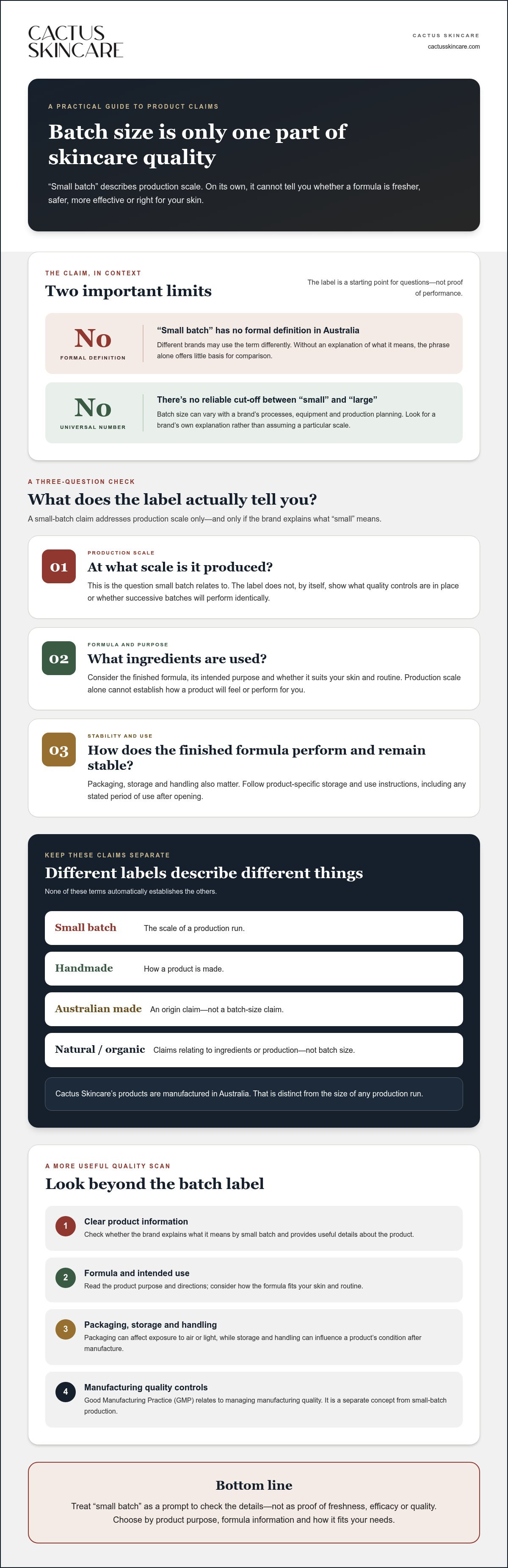
Small batch describes the scale of a production run, not a guaranteed level of performance. In Australia, “small batch” has no formal, universally accepted definition, so one brand’s use of the term may not match another’s. Without a stated batch size or an explanation of how products are made, the label alone can’t tell you whether a formula is fresher, safer or more effective.
A useful distinction is: small batch is a manufacturing choice; finished-product quality depends on the formula, its production controls and how it’s handled. A smaller run may suit a brand’s production planning, but it doesn’t automatically mean closer quality control or better results for your skin. When comparing products, look for information that helps you judge the formula and its intended use, not just the scale of production.
What does a skincare batch refer to?
A batch is a production run made under defined manufacturing conditions. Its size can vary according to a brand’s processes, equipment and production planning, so there’s no reliable universal number that separates “small” from “large”. The term is most useful when a brand explains what it means by small batch, rather than relying on the phrase as a quality signal.
Consistency matters across production runs. Good Manufacturing Practice (GMP) describes approaches to managing manufacturing quality. It’s a different concept from small-batch production. A limited run on its own doesn’t show what quality controls are in place or prove that successive batches will perform identically.
Is small-batch skincare always handmade or Australian made?
No. These claims describe different things. Small batch refers to production scale; handmade describes how a product is made; and Australian made is an origin claim. Natural and organic relate to ingredients or production claims, not batch size. None of these labels automatically establishes the others.
For Australian-made claims, check the relevant definitions and requirements against current Australian guidance. A product manufactured in Australia isn’t necessarily produced in small batches, just as a small production run doesn’t establish Australian origin. Cactus Skincare’s products are manufactured in Australia, which is a distinct point from the size of any production run.
So, when you see small batch skincare Australia, treat it as a prompt to look for clearer product information, not as proof of freshness or efficacy. Production scale may be part of a brand’s approach, but the label alone can’t tell you whether the skincare suits your needs.
Myth versus fact: does small-batch skincare stay fresher or work better?
Myth: a smaller production run automatically means fresher, more effective skincare. Batch size alone can establish neither. Ingredient quality, the finished formula and manufacturing scale are separate considerations. Good ingredients don’t guarantee a well-designed formula, and a carefully developed product isn’t automatically better because fewer units were made.
There’s no shortcut from production scale to results. A product’s intended purpose, formulation and use all shape how it performs for an individual. The science of cosmetic formulation includes product development, safety and stability, illustrating why a formula’s design and behaviour matter beyond the size of a production run.
Does a smaller production run mean fresher skincare?
Not necessarily. Production timing is only one part of a product’s journey. Packaging can affect how much the formula is exposed to air or light, while storage and handling can influence its condition after manufacture. Without evidence about a particular product’s production and distribution, a small-batch claim can’t show that it reaches you sooner or stays fresher. Follow the product-specific storage and use instructions, and pay attention to any stated period of use after opening.
Can small-batch skincare deliver better results?
It can be well formulated, but batch size doesn’t prove that it’s stronger, safer or more effective. Results depend on whether the formula is suited to its intended use and your skin, as well as how consistently you apply it. Look for clear, substantiated information about the product’s purpose and directions rather than treating production language as evidence of performance.
Think of it as three distinct questions: What ingredients are used? How does the finished formula perform and remain stable? At what scale is it produced? A small production run answers only the last question, and only if the brand explains what “small” means. It can’t, by itself, tell you how the formula will feel on your skin or fit into your routine.
For small batch skincare Australia claims, let the product details lead. Read the directions, follow storage guidance and choose according to your skin’s needs, rather than assuming smaller means better. If you’re comparing products by origin and routine fit, explore Australian-made facial skincare as one example of a range manufactured in Australia, without equating local manufacture with small-batch production.
What matters more than batch size: formulation, stability and traceability
A useful quality check looks beyond how much is made. Consider whether the formula suits your skin and intended use, how the packaging protects it, whether storage instructions are clear and what information the brand provides. These details help you assess a product more meaningfully than a small-batch label alone.
How formulation and packaging affect product quality
Formulation and packaging work together. A product’s ingredients and structure influence how it behaves over time, while its container may affect exposure to air, light or contamination during use. A pump, tube or jar can each have advantages depending on the formula and how the product is designed. No packaging type is automatically best for every skincare product.
Stability testing, in simple terms, examines how a product changes under selected conditions over time. It can help inform whether a formula maintains its intended characteristics, but the approaches used may differ according to the product. Testing isn’t a single universal process, and a small batch doesn’t tell you which assessments were carried out. For everyday use, follow the product’s storage guidance and pay attention to its stated period of use after opening, where provided.
What traceability and manufacturing transparency can tell you
A batch identifier can connect a finished product to production information. That can support traceability by helping a manufacturer distinguish one run from another and follow relevant records. It’s useful context, but it isn’t proof that a product will deliver a particular skin benefit or suit every person.
Clear product information is another practical signal. Look for an ingredient list, directions, product purpose and storage advice. If a brand explains its manufacturing approach, that may help you understand its processes, but transparency about production and evidence of skin benefits are different things.
Terms such as clean, natural and ethical also describe separate qualities, and their meanings can vary. Look for a clear explanation of what each claim refers to rather than treating the wording as a standardised measure of quality. For example, an ingredient-origin statement doesn’t tell you how stable the finished formula is, while an ethical sourcing claim doesn’t establish whether it suits your skin.
For small batch skincare Australia claims, use a practical checklist: formula fit, suitable packaging, clear storage guidance, useful product details and meaningful traceability. Together, these offer a more considered basis for choosing skincare than production scale alone.
How to assess small-batch skincare claims in Australia
A thoughtful check separates what a label says from what it can demonstrate. For small batch skincare Australia, assess the product itself as well as the production claim. No single term, logo or batch code guarantees quality, suitability or results.
Which details help you assess a skincare product?
Start with the information that helps you understand what the product is designed to do and how to use it. Look for:
- Product purpose: Is its intended use explained clearly?
- Ingredient information: Is there a full ingredient list you can read and assess for your needs?
- Directions and storage: Are instructions clear, including any guidance on keeping the product in good condition?
- Freshness or performance claims: Are these specific, with a clear basis rather than a broad promise?
- Batch details: Does the brand explain what its batch information means? Treat it as useful production context, not proof of skin benefits.
A practical summary: clear, product-specific information is more useful than broad marketing language; batch details add context, but don’t establish how a formula will perform.
How to read Australian-made and ingredient claims
Manufacturing location and ingredient origin are separate. A product may be manufactured in Australia while using ingredients sourced from elsewhere, so “Australian made” doesn’t automatically mean every ingredient is Australian. Likewise, a native botanical ingredient doesn’t by itself establish where the finished product was made.
Different Australian bodies have different roles. AICIS oversees the introduction of industrial chemicals, including ingredients used in cosmetics. The TGA regulates products making therapeutic claims, while the ACCC enforces Australian Consumer Law, including protections against misleading or deceptive claims. The Australian Made Campaign provides guidance on its country-of-origin claims and logo. Check current information from these organisations before relying on a particular claim or drawing a legal conclusion. A logo or regulator reference doesn’t certify every attribute of a product.
Keep sustainability statements distinct, too. Claims about sourcing, packaging or environmental impact should identify what they refer to; they don’t automatically verify a product’s formulation, Australian origin or production scale.
Use the checklist to assess a considered range on its own terms. Cactus Skincare’s facial products are manufactured in Australia, a point distinct from batch size. Explore Australian-made facial skincare and consider which products suit your routine.
Choosing Australian small-batch skincare for a thoughtful routine
A considered routine starts with your skin’s needs, not a production label. Whether you’re comparing small batch skincare Australia claims or looking at Australian-made products, batch size and manufacturing origin don’t establish that a product will suit you or deliver superior results. Use clear product information, intended purpose and fit with your existing routine to guide your choice.
Match skincare to your routine, not a production label
First, identify what you want your routine to do. A cleanser has a different role from a moisturising crème, and a product intended for daytime use serves a different place in your day-to-day ritual from a night serum. If you’re considering targeted care, look closely at the product’s stated purpose and directions rather than assuming it addresses a particular concern.
Build with intention. You might begin with the step your routine is missing, such as cleansing or hydration, then consider whether another product has a clear role alongside it. Introduce products thoughtfully and follow their individual directions. This makes it easier to understand how each fits your routine, rather than changing several steps at once and being unsure which product suits you.
Keep expectations realistic, too. A product name or production claim isn’t a promise of a particular outcome. Give greater weight to relevant product information and whether its intended use aligns with your needs.
What Australian-made skincare can offer shoppers
Australian manufacture can be a meaningful consideration for shoppers who want to know where a finished product is made, but it doesn’t tell you the batch size, ingredient origin or likely results. Those are separate questions. Assess each claim on its own terms, then decide whether the product belongs in your routine.
Cactus Skincare is an independent Australian-owned brand, and its products are manufactured in Australia. The range includes products with distinct routine roles, such as the Lemon Myrtle cleanser for cleansing and the Regenerative night serum as a night-time serum option. These are examples of Australian-made facial skincare, not evidence of small-batch production or a guarantee of specific results.
Let routine fit lead: consider what you need, read the product information and choose at a pace that feels comfortable. Explore the Cactus Skincare range to discover facial skincare options and consider which products suit your ritual.
Choose skincare with clarity and confidence
The key insight behind small batch skincare Australia is simple: batch size describes production scale, not guaranteed freshness, quality or results. Look instead at the formula, product information, packaging and storage guidance, then consider whether the product suits your skin and routine. Australian-made and small-batch are separate claims, just as ingredient origin and sustainability statements each need to be understood on their own terms.
Cactus Skincare is an Australian-owned skincare brand with products manufactured in Australia. Its curated facial range includes serums, crèmes, cleansers, facial oils and a mask, with options for different steps in a routine. Australian manufacture offers useful origin information, while product purpose and fit remain personal considerations.
Explore the range and choose products for the role they’ll play in your routine. Explore Australian-made facial skincare from Cactus Skincare and take a thoughtful next step towards skincare that feels right for you.
Frequently Asked Questions
What does small-batch skincare mean?
Small-batch skincare usually refers to products made in smaller production runs, but there’s no formal Australian definition or universal size threshold. Brands may use the phrase differently, so look for an explanation of what it means in that brand’s manufacturing context. It describes production scale, not necessarily how a product is made, where it’s made, or whether it’s natural, organic or higher quality.
Is small-batch skincare better for your skin?
Not automatically. A smaller production run doesn’t prove that a formula is safer, more effective or better suited to your skin. Suitability depends on the finished formula, its intended purpose and how it fits your individual needs and routine. Read the product information and directions, and consider the ingredients that matter to you. Treat batch size as production context, not evidence of superior skin results.
Does small-batch skincare stay fresher for longer?
Not necessarily. A smaller run alone doesn’t show when a product was made, how it was packaged or how it was stored and handled before purchase. These factors, along with the formula, can affect a product’s condition. Follow its specific storage and use instructions, including any guidance on use after opening. Don’t assume a small-batch label means the product is fresher or lasts longer.
Is Australian-made skincare the same as small-batch skincare?
No. Australian-made refers to where a product is manufactured, while small-batch refers to the scale of a production run. One claim doesn’t establish the other, and Australian manufacture doesn’t automatically mean ingredients are Australian-sourced or that results will be superior. Cactus Skincare is an Australian-owned brand with products manufactured in Australia, but that origin information doesn’t by itself define production batch size.
Can small-batch skincare be suitable for sensitive skin?
It may suit some people with sensitive skin, but batch size can’t predict how your skin will respond. Check the full ingredient list and the product’s intended use, then follow its directions. If you’re trying something new, consider introducing one product at a time and patch testing according to its instructions. Stop using it if irritation occurs. “Small batch” isn’t a sensitive-skin guarantee.
What should I look for when buying small-batch skincare in Australia?
For small batch skincare Australia shoppers, useful checks include a clear product purpose, full ingredient information, directions and storage guidance. Look for specific explanations behind freshness or performance claims, rather than relying on broad promises. Keep manufacturing origin separate from ingredient origin, and treat batch details as context rather than proof of efficacy. Choose a formula that fits your skin and routine, not just an appealing label.