

Sensitive Skincare in Australia: A Calm, Evidence-Led Guide
A botanical label doesn’t guarantee a gentle experience. If your skin flushes, stings or feels tight after a new product, finding skincare for sensitive skin Australia can feel like guesswork, especially when “natural” and “clean” claims compete for attention.
It’s understandable to want a routine that feels comfortable without removing every step your skin relies on. Sensitivity can have different triggers, and a reaction alone can’t tell you whether you have a skin condition. The formula, how often you use a product and your own response all matter.
This guide explains how to recognise common signs of sensitivity without self-diagnosing, compare product information and introduce changes methodically. You’ll also find practical ways to simplify cleansing, moisturising and daytime sun protection. The aim isn’t to find a universal “sensitive skin” formula. It’s to build a routine around tolerance, consistency and what you observe.
Key Takeaways
- Stinging, tightness or redness can signal skin reactivity, but these experiences alone don’t diagnose a skin condition.
- Build a simple routine around gentle cleansing, moisturising and daytime sun protection, then observe how your skin responds.
- For skincare for sensitive skin Australia, compare full product information rather than relying on “natural” or “botanical” claims alone.
- Introduce one new product at a time and follow its directions for testing. A small-area test can’t guarantee you won’t react later.
- Let formula details and personal tolerance guide your choices. Cactus Skincare is Australian-owned, and its products are manufactured in Australia.
What does sensitive skin mean, and how can you recognise it?
Stinging after cleansing, tightness beneath moisturiser or visible redness can make familiar skincare choices feel uncertain. These experiences are worth noticing, but they don’t automatically reveal what caused them or identify a skin condition. Sensitivity describes how skin feels or reacts; it isn’t a diagnosis.
In practical terms, “sensitive skin” describes skin that reports discomfort or shows a reaction, while a diagnosed skin condition requires assessment by a qualified health professional. This distinction helps keep skincare for sensitive skin Australia grounded in observation rather than guesswork. A general overview of what sensitive skin can involve may help explain the term, but it can’t determine the cause of your own symptoms.
What can sensitive skin feel like?
People may describe tightness, stinging, itching, burning or tenderness. Visible redness can occur, too, although some people feel discomfort without an obvious change in appearance. Experiences vary: one person might notice a brief sting after applying a product, while another finds their skin persistently dry or easily unsettled. No single sensation or patch of redness proves a particular condition.
Sensitive skin or a diagnosed skin condition?
Calling your skin sensitive doesn’t establish an allergy, eczema, rosacea or another diagnosis. Similar sensations can have different explanations, and timing alone may not identify the cause. If discomfort is persistent, painful, severe or worsening, speak with a GP or dermatologist for assessment rather than trying to diagnose it through product changes alone. For individuals diagnosed with chronic facial redness, dedicated resources like the Rosacea Treatment Clinic provide skincare solutions specifically formulated for rosacea.
It can help to note the pattern without drawing conclusions. Record when discomfort appears, where it occurs, which products you recently introduced and whether stopping a product changes how your skin feels. For example, note whether tightness follows cleansing or stinging begins after applying a particular product. These observations can give a health professional useful context, but they aren’t a substitute for assessment.
A short-lived sensation that settles is different from an ongoing or escalating problem, though that distinction can’t confirm what is happening. If a product causes marked discomfort, stop using it and avoid adding several new products to work out the cause. Keep your next steps simple and measured. The aim is not to label your skin, but to recognise its signals and respond with care.
How to build a simple skincare routine for sensitive skin
A shorter routine makes product choices easier to manage and gives you a clearer view of what you’re applying. It also makes it easier to notice how your skin responds, without assuming that one formula or ingredient list will suit everyone who describes their skin as sensitive. Keep the essentials steady, then make considered adjustments rather than changing several steps at once.
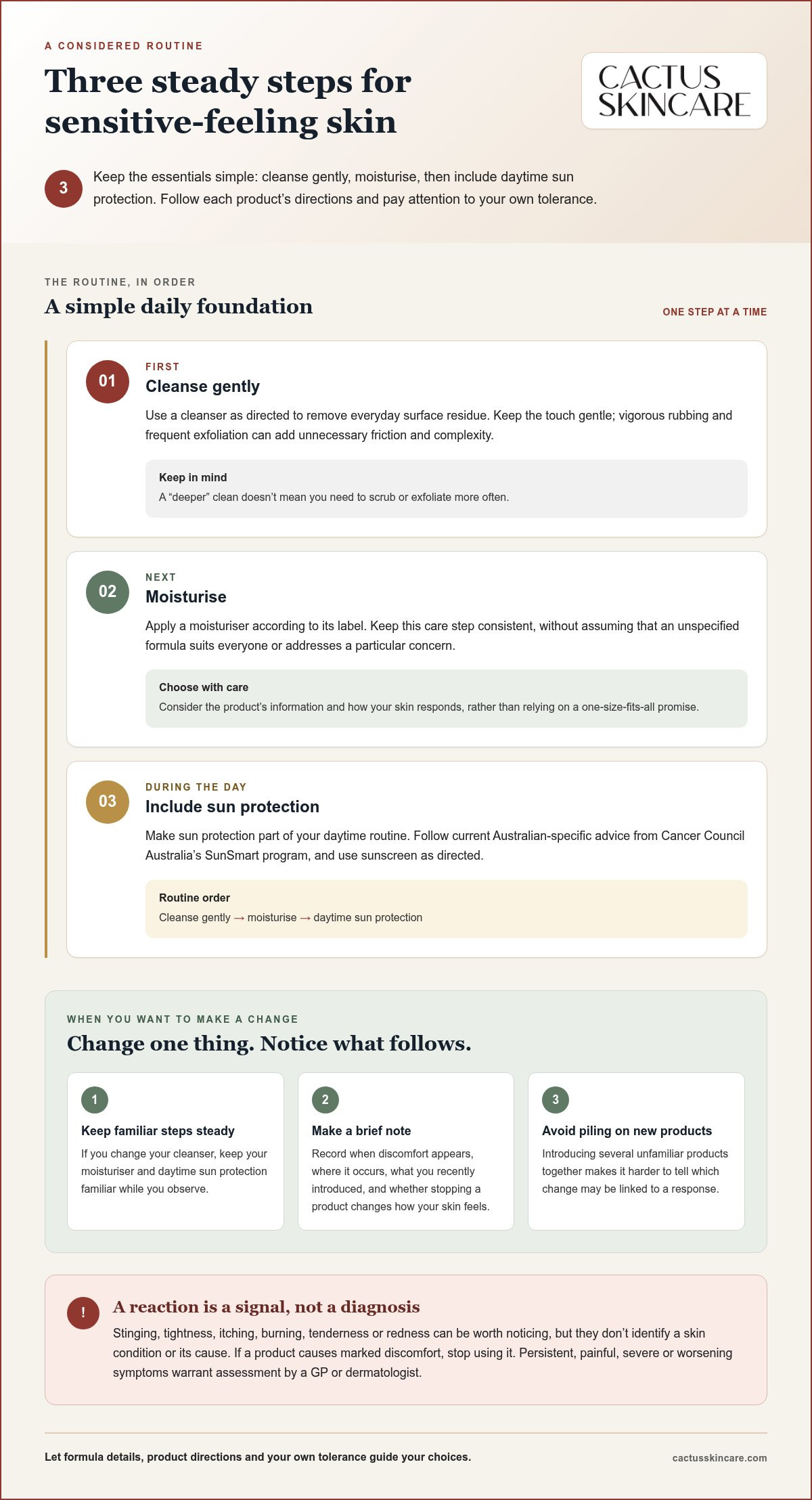
A simple routine follows three steps: cleanse gently, moisturise, then apply daytime sun protection. This is a practical starting point, not a promise that discomfort will resolve or a prescription for every skin type.
Which steps are the starting point?
Each step has a distinct purpose. Cleansing removes everyday residue; moisturising is a regular care step; sun protection helps protect skin from UV exposure. Follow product directions and consider your own tolerance. Scrubbing or exfoliating more often in pursuit of a “deeper” clean can add unnecessary friction and complexity.
- Cleanse gently: Use a cleanser as directed to remove surface residue. Avoid vigorous rubbing and frequent exfoliation.
- Moisturise: Apply a moisturiser according to its label. Keep this step consistent, but don’t assume an unspecified formula will suit everyone or address a particular skin concern.
- Protect during the day: Include sun protection in your morning routine. For Australian-specific advice, follow current guidance from Cancer Council Australia’s SunSmart program and use sunscreen as directed.
How can you simplify without overlooking your needs?
Start with the steps that fit your everyday routine, rather than adding products to reach a particular number. If you already have products you tolerate, you don’t need to replace them all at once. Keep track of what you use and when your skin feels different. A brief note can help you spot patterns without treating them as a diagnosis.
Introduce one change at a time. If you want to replace your cleanser, for example, keep your moisturiser and daytime sun protection familiar while you observe how the new cleanser feels. Adding several unfamiliar products together makes it harder to identify which change may be linked to a response.
There’s no universal routine for self-described sensitivity. Your skin’s needs, the formulas you tolerate and the directions on each label all matter. If a product causes discomfort, pause that change rather than layering on more products to counteract it. Persistent, painful or worsening symptoms call for professional assessment, not a more elaborate routine.
Choose products by their formula and the role they serve, not by how many steps they promise. Cactus Skincare’s facial skincare range includes cleansers and crèmes, alongside serums, facial oils and masks. Review each product’s information and consider how a format fits your routine before introducing it.
Natural, fragrance-free or active: what should sensitive skin shoppers compare?
A “natural” or botanical label can sound reassuring, while “fragrance-free” may seem like a clear signal. But these descriptors don’t predict exactly how your skin will respond. When comparing skincare for sensitive skin Australia, read the product information and consider your own experience instead of treating a label as a guarantee of comfort or suitability.
Does natural skincare always suit sensitive skin?
No. Botanical origin alone can’t predict an individual response, just as a synthetic ingredient isn’t automatically unsuitable. Plant extracts, essential oils and preservatives belong to broad groups with different properties and uses, so blanket rules can mislead. Review the full product information and consider your own history: which formulas have felt comfortable, and which have caused a reaction?
How should you think about fragrance and active ingredients?
Fragrance information can help you make choices based on your preferences and past responses. If you’ve noticed discomfort with fragranced products, that experience may guide what you choose to try next. It doesn’t establish that every product containing fragrance will affect you in the same way.
Active ingredients aren’t automatically appropriate or inappropriate for sensitive skin. Their purpose, concentration, the overall formulation and how often a product is used can all influence how it feels. Concentrations may not always be clear from the information available, so don’t infer a precise strength from an ingredient’s position alone.
Assess the product as a whole. Read its directions, note any fragrance information and consider whether its intended function fits your needs. If you decide to try it, introduce it as a single change so you can observe your response more clearly. A label is a starting point for a considered choice, not a personal suitability test.
How to introduce a new skincare product and monitor your skin
A careful trial can make a new product easier to assess, but it can’t remove all uncertainty. When choosing skincare for sensitive skin Australia, use product directions as your guide, change one thing at a time and pay attention to how your skin responds. A small-area test is preliminary, not a guarantee of future tolerance.
A small-area test can offer an early indication of how your skin responds, but it can’t guarantee you’ll tolerate the product every time or with continued use. Skin may respond differently across areas or with repeated application, so treat the result as one piece of information, not a clearance to use a product without care.
How can you trial a new product thoughtfully?
Before applying anything, read the label and follow its directions, including any testing guidance. Avoid applying an unfamiliar product to irritated or broken skin. If you’re already changing other parts of your routine, wait until those changes are easier to assess before adding another variable.
Introduce one new product at a time. Keep other routine steps familiar, and make a brief record of the product, when you used it and anything you noticed afterwards. This gives you a clearer picture than relying on memory, particularly if a sensation or visible change appears later.
- Note the context: Record the date, application area and whether your skin felt comfortable, tight, itchy or otherwise different.
- Keep the routine steady: Avoid starting several unfamiliar products together, so you can better identify which change may be associated with a response.
- Follow the label: Don’t increase frequency or use the product differently from its directions just to speed up a trial.
When should you pause and seek professional advice?
If a product causes marked discomfort, stop using it rather than pushing through or adding other products to counteract the feeling. Persistent discomfort also deserves attention. A reaction can’t be reliably identified as an allergy from appearance alone, so avoid self-diagnosing or treating a suspected skin condition based on a product trial.
Seek advice from a GP or dermatologist if symptoms are severe, spreading, recurring or not settling. Your product notes can help you explain what you used and when you noticed a change. Bring the product packaging or ingredient information if it’s useful for discussing the sequence of events.
Take a measured approach: follow directions, introduce one new product, then observe your skin. To compare options for your routine, explore Cactus Skincare products and review each product’s information before deciding what to trial. No testing method can promise a particular response, so let your experience guide your next step.
Choosing Australian skincare for sensitive skin with a considered routine
A thoughtful choice starts with the formula, not a promise on the front of the pack. Keep your routine purposeful, read product information closely and let your own response guide what earns a place in it. This approach makes skincare for sensitive skin Australia less about finding a universal answer and more about making deliberate, observable choices.
Australian ownership and manufacture are useful facts when learning about a brand. They tell you about the business and where its products are made, but don’t establish how a formula will feel on your skin or whether it’s clinically suitable for an individual concern.
How can product categories fit into a considered routine?
Think about product categories by their place in your routine, rather than as solutions to sensitivity. A cleanser, serum, crème, facial oil or cleansing balm has its own format and purpose; the category alone can’t tell you whether a particular product suits you. Read the label to understand what it is, then consider whether it fits a genuine need in your routine.
- Cleanser or cleansing balm: Consider the cleansing step you need and the directions for using the product. Cactus Skincare’s range includes a Lemon Myrtle cleanser and a Cleansing Balm.
- Serum: Review the product information to understand its intended role before deciding whether to add it. Cactus Skincare offers a Protective day serum and a Regenerative night serum.
- Crème or facial oil: Consider where the format might fit in your routine, alongside your experience with similar products. The range includes the Intense Hydrating Crème and facial oils.
Keep the decision personal. There’s no need to build a more elaborate routine simply because a format is available. Formula details, a clear purpose in your routine and your observed tolerance matter more than assuming a product category is inherently suitable for sensitive skin.
What does Australian manufacture tell you, and what doesn’t it?
Cactus Skincare is an Australian-owned brand, and its skincare products are manufactured in Australia. That’s a clear point of origin, not a prediction of individual tolerance, a guarantee of a particular result or evidence that a product is clinically suitable for everyone. Assess each product using its information and your own experience.
For a considered next step, choose only what has a clear role in your routine, review the product details and introduce changes with care. You don’t need to select a product just because it carries a particular descriptor or belongs to a familiar category. Let your needs and response remain central.
To explore the range, visit Cactus Skincare and compare the product formats and information as you plan your routine.
Let your routine evolve with your skin
Your skincare routine doesn’t need to stay fixed forever. As seasons, habits and preferences change, revisit what each step contributes and whether it still feels right for you. A brief note about products you use and how your skin responds can help you make future choices with more clarity, rather than starting from scratch each time.
The most considered approach to skincare for sensitive skin Australia is personal, not perfect. Keep what works for your routine, set aside what doesn’t and make the next change deliberately. If you’re looking for products to consider, explore Cactus Skincare’s facial skincare.
Small, informed choices can make skincare feel more manageable. Keep listening to your skin, and let your routine grow at a pace that feels comfortable.
Frequently Asked Questions
Is sensitive skin the same as an allergy?
No. “Sensitive skin” describes a pattern of discomfort or reactivity, while an allergy is a specific immune response. The sensations or appearance of a reaction alone can’t reliably distinguish allergy from irritation or another cause. If the same product repeatedly brings on a reaction, stop using it and discuss the pattern with a GP. Seek urgent help for severe symptoms such as difficulty breathing or swelling of the face or throat.
Can sensitive skin develop later in life?
Yes. Skin responses can change over time, so someone who previously tolerated a product may find it feels different later. Changes in climate, daily exposures, medication or routine may be relevant, but they don’t identify the cause on their own. If sensitivity appears suddenly, persists or keeps recurring, note what has changed and discuss it with a GP or dermatologist rather than assuming it’s simply ageing.
How do you patch test a new skincare product?
Start with the product label, as testing directions can differ between products. If directed, apply the stated amount to a small area of clean, intact skin at the location specified, then observe it for the period described. Don’t test several unfamiliar products at once or apply a product to irritated skin. A local test can show an early response at that site, but it can’t establish how your face will respond with ongoing use.
Is fragrance-free skincare always better for sensitive skin?
No. If you’re searching for skincare for sensitive skin Australia, treat fragrance-free as one preference to consider, not a guarantee that a product will suit you. It may be relevant if you’ve noticed discomfort with fragranced products, but a fragrance-free formula can still contain other ingredients your skin doesn’t tolerate. Read the product information and consider your own history; a fragranced product doesn’t automatically cause a reaction for everyone.
Can people with sensitive skin use active ingredients?
Often, yes. Self-described sensitivity doesn’t automatically rule out every active ingredient. Consider the product’s intended purpose, directions and how it fits with what you already use. For instance, avoid introducing several products with unfamiliar actives at the same time, as it can be harder to work out what your skin responds to. If you’re managing a diagnosed condition or using prescribed skincare, ask your treating health professional before changing your routine.
Should I stop using skincare if my skin feels irritated?
If a product causes marked irritation, stop using it and don’t reapply it to see whether the response happens again. If it’s still on your skin, rinse it off gently with lukewarm water. Avoid adding another unfamiliar product to calm the area. For severe, spreading or recurring symptoms, seek medical advice. Difficulty breathing or swelling of the face or throat needs urgent attention: call 000.
Does sensitive skin still need daily sun protection in Australia?
Yes. Skin sensitivity doesn’t remove the need to protect against UV. Cancer Council Australia’s SunSmart guidance recommends using sun protection when the UV Index is 3 or above. Check the daily UV forecast, and choose a broad-spectrum, water-resistant SPF 50 or 50+ sunscreen, applying and reapplying it as directed. Clothing, a broad-brimmed hat, sunglasses and shade add practical layers of protection, especially during extended time outdoors.