

Light Balancing Moisturiser: The Botanical Guide to Skin Equilibrium
What if oily yet dehydrated skin needs hydration, not a harsher effort to remove oil? In humid weather, a moisturiser that feels filmy or heavy can be uncomfortable. If your skin is easily unsettled, choosing what to apply can feel like another risk. A well-chosen light balancing moisturiser can provide hydration in a texture that feels more comfortable.
Skin balance isn’t about stripping away oil. It’s about supporting hydration with a formula that feels right for your skin. Cactus Skincare’s Australian-made Light Balancing Crème is designed for people seeking hydration without the weight of an intense crème. The brand’s botanical approach includes Prickly Pear and Cactus extracts.
This guide explains how to choose lightweight hydration, why oily skin can still feel dehydrated, and what to consider when skin is easily unsettled. You’ll also find practical ways to compare crème textures and build a simple routine, so you can choose products according to how your skin feels rather than relying on broad promises.
Key Takeaways
- Learn to distinguish surface oil from tightness or discomfort that may signal your skin needs hydration, without over-stripping.
- Assess botanical ingredients such as Prickly Pear and Cactus extracts by looking for specific ingredient information, not just broad claims.
- Compare lighter and richer crème textures, then adjust according to how your skin feels as conditions change.
- Keep your routine easy to follow with a simple sequence: cleanse, apply serum if you use one, then moisturise.
- Consider where a product is made, but use the full ingredient list and your own skin’s response to guide your choice.
What Is a Light Balancing Moisturiser?
A light balancing moisturiser provides hydration in a comfortable, lightweight texture. It can help skin feel supple without a heavy or greasy finish. “Balancing” describes the aim of meeting skin’s moisture needs without a texture that feels excessive on oilier areas. It doesn’t necessarily mean a moisturiser controls sebum production. Oil levels are influenced by skin biology and other factors.
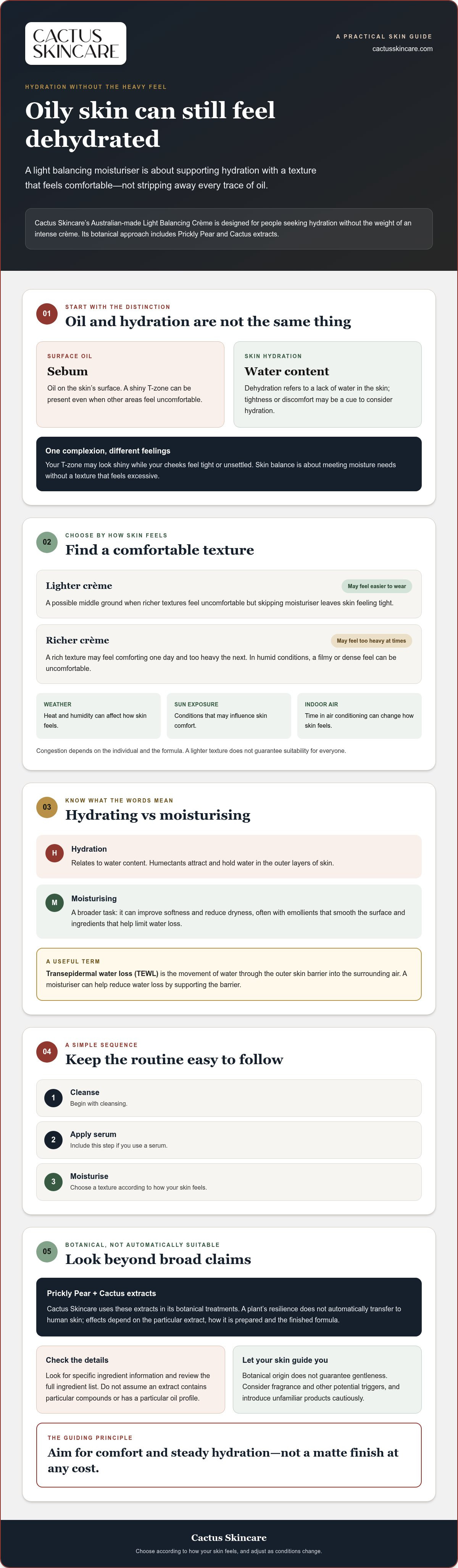
This distinction helps explain why skin can feel oily and dehydrated at the same time. Sebum is oil, while dehydration refers to a lack of water in the skin. Your T-zone may look shiny while your cheeks feel tight or uncomfortable. Heat, humidity, sun exposure and time in air conditioning can all affect how skin feels. A rich crème may feel comforting one day and too heavy the next. A dense texture can also feel uncomfortable on the surface in humid conditions, although congestion depends on both the individual and the formula.
For reactive skin, lightweight hydration is about comfort, not removing every trace of oil. A lighter texture may feel easier to wear, but botanical or “natural” ingredients aren’t automatically suitable for everyone. Check the full ingredient list and introduce unfamiliar products cautiously. Cactus Skincare’s Light Balancing Crème is formulated for people seeking hydration without the weight of an intense crème.
The Difference Between Hydrating and Moisturising
Hydration refers to water content. Humectants attract and hold water in the outer layers of skin. Moisturising is a broader task: it can improve softness and reduce dryness, often with emollients that smooth the surface and ingredients that help limit water loss. A balancing crème aims to support hydration and comfort without leaving a coating that feels too heavy. For a foundational overview of what moisturizers are, including humectants, emollients and occlusives, see Wikipedia.
Transepidermal water loss (TEWL) is the movement of water through the outer skin barrier into the surrounding air. A moisturiser can help reduce water loss by supporting the barrier.
Who Should Consider a Light Balancing Formula?
Combination skin often has an oilier forehead, nose and chin, with drier or more easily unsettled cheeks. A lighter crème can be a practical middle ground if richer textures feel uncomfortable but skipping moisturiser leaves skin tight. People with reactive skin may also prefer a simple, wearable texture, although sensitivity varies and no formula can be assumed to suit everyone.
Let your skin’s response guide you. If changes in weather or indoor conditions affect how your complexion feels, adjust the texture rather than stripping your skin to address shine. Aim for comfort and steady hydration, not a matte finish at any cost.
Botanical Extracts and Skin Health
Plants that thrive in dry environments have adapted to manage water stress, making cactus an interesting source of inspiration for skincare. A plant’s resilience doesn’t automatically transfer to human skin, however. The effect depends on the particular extract, how it is prepared and the finished formula. Cactus Skincare uses bioactive Prickly Pear and Cactus extracts in its botanical treatments. Without specific ingredient details, it’s best not to assume the extracts contain particular compounds or have a particular oil profile.
“Balancing” also shouldn’t be taken to mean a botanical ingredient switches off oil production. Sebum is regulated by several biological and environmental factors, and a moisturiser’s effect depends on its formulation. Plant-derived ingredients can contribute to hydration and skin comfort, while the finished product’s texture influences how it feels. These are useful goals without promising that an extract will regulate sebum.
What to Know About Cactus Extract in Skincare
Prickly Pear seed oil is often discussed for its fatty-acid and vitamin E content. Those properties shouldn’t be assumed to describe every cactus extract or a particular brand’s formula. The Linus Pauling Institute outlines how essential nutrients for skin health support skin structure and function. In a formulated crème, cactus-derived ingredients may help support the skin’s natural barrier, depending on their composition and the evidence available for the finished product.
That distinction matters if your skin is reactive. A botanical origin doesn’t guarantee gentleness, just as a synthetic ingredient isn’t inherently unsuitable. Review the full ingredient list, consider fragrance and other potential triggers, and introduce unfamiliar products cautiously.
Why Formula Design Matters
Bioavailability describes how readily an ingredient becomes available for the body or skin to use. In skincare, its practical relevance depends on the ingredient, its form and how it is delivered in the formula. A label featuring a striking plant extract alone can’t tell you how much is present or what effect it may have. Formula design matters.
There’s no universal category of “filler” ingredients that simply sit on the surface and cause congestion. Ingredients serve different functions, and tolerance varies from person to person. When comparing products, look beyond a headline ingredient and review the full ingredient list and product information.
For a lighter-feeling option, Cactus Skincare’s Light Balancing Crème is formulated to hydrate without the weight of an intense crème. You can explore the Light Balancing Crème as one example of its botanical approach.
Choosing a Texture: Light Balancing vs Intense Hydrating Crèmes
The right moisturiser meets your skin’s current needs and feels comfortable enough to use consistently. Texture offers a useful starting point. A lighter crème may suit skin that dislikes a rich finish, while a more emollient crème may feel reassuring when dryness or tightness is more noticeable. Absorption and finish depend on the whole formula, so products in the same category won’t necessarily feel or perform alike.
Think about seasonal changes, but let your skin lead. Warm, humid weather may make a lighter texture more comfortable. Cooler conditions or indoor heating may leave some complexions wanting a richer feel. You don’t need to switch on a calendar date. Notice whether your skin feels tight after cleansing, becomes uncomfortable through the day or finds a heavier layer too much.
The Light Balancing Crème Profile
A light balancing moisturiser may suit combination or oil-prone skin, or anyone who wants hydration without the weight of a richer crème. Cactus Skincare’s Light Balancing Crème is formulated for people seeking that middle ground. Its lighter positioning alone doesn’t substantiate claims that it refines pores, calms redness or prevents congestion. Those outcomes depend on the formula and individual response. If your skin is reactive, check the ingredient list and introduce new skincare carefully.
The Intense Hydrating Crème Profile
A richer moisturiser may be worth considering if your skin often feels dry, tight or uncomfortable, including during colder weather. Cactus Skincare’s Intense Hydrating Crème offers a different hydration profile from its lighter crème. A richer texture can support softness and ease the feeling of dryness, but claims such as restoring the lipid barrier or reducing fine lines shouldn’t be assumed without product-specific evidence. Choose according to how your skin feels, not age alone.
Can a light moisturiser still be part of an anti-ageing routine? Yes. It can be part of a consistent routine by helping skin stay hydrated and comfortable. But “light” describes a texture, not a proven anti-ageing effect. Fine lines can look more noticeable when skin is dry, while changes associated with ageing have multiple causes. Don’t expect a moisturiser alone to prevent or reverse them.
Antioxidants are another ingredient category to assess, not a benefit to assume. The product information here doesn’t confirm that both crèmes contain antioxidants, so check each product’s current ingredient list rather than relying on the product type. For daytime, pair a comfortable moisturiser with sun protection appropriate to your routine. The best seasonal adjustment is straightforward: use the texture that leaves your skin feeling comfortably hydrated, not coated or tight.
A Simple Application Routine
A useful routine is less about applying more and more about choosing a comfortable order. Start by cleansing with the Lemon Myrtle cleanser as directed, rinse thoroughly and pat your face dry without rubbing. Clean skin gives your next products a clear surface, while a gentle touch helps avoid unnecessary friction.
Apply serum before crème. Lighter textures generally go on first, followed by moisturiser. Use the Protective Day Serum or Regenerative Night Serum according to its directions, then smooth on the Light Balancing Crème if it suits your skin. Product instructions take priority, especially if they recommend a different order.
Morning Routine: Protective Day Serum
In the morning, cleanse, apply the Protective Day Serum as directed, then follow with crème. The moisturiser can complement the serum by providing a final layer of hydration, but don’t assume it locks in antioxidants or creates a sun-protective shield. For daytime UV protection, use a broad-spectrum sunscreen as directed. A moisturiser or serum shouldn’t replace it. If you wear makeup, allow each layer to settle and adjust the amount of crème if your base feels slippery or heavy.
Evening Routine: Regenerative Night Serum
At night, cleanse away the day, apply the Regenerative Night Serum according to its directions, then finish with crème if it suits your skin. Evening care is an opportunity to follow a consistent routine, not a guaranteed shortcut to repair. Avoid adding extra facial oils unless they’re already part of your routine and your skin tolerates them.
A gentle application technique: Warm a small amount of crème between clean fingertips. Press it gently onto your forehead, cheeks, chin and neck, then use light, outward strokes to distribute it. Avoid tugging or vigorous rubbing, particularly over areas prone to redness.
A three-minute evening massage:
- Minute one: With clean hands and crème applied, press lightly across the forehead, moving from the centre towards the temples.
- Minute two: Glide gently from the sides of the nose across the cheeks towards the ears, keeping pressure comfortable.
- Minute three: Sweep along the jaw from chin to ears, then use soft upward strokes on the neck. Stop if the skin feels sore or irritated.
Keep the routine calm and consistent, and let your skin’s comfort guide how much crème you use. Explore Cactus Skincare’s botanical skincare to see products that may fit into your routine.
Skincare for Changing Conditions
Skincare should respond to how your skin feels, not rely on broad promises. Warmth, humidity, sun exposure and time in air conditioning can all affect comfort. Australian-made alone doesn’t prove that a formula was designed for a particular UV level or climate; it tells you where a product is made. Cactus Skincare is an Australian-made and Australian-owned brand with a botanical approach.
For people who find richer textures uncomfortable, the Light Balancing Crème is formulated to provide hydration without the weight of an intense crème. It can be a considered middle ground when your skin wants moisture but not a heavy finish. Choose according to how your skin responds rather than assuming one texture suits everyone.
How to Assess Product Claims
When assessing a product’s origin, look for specific information about its ingredients and manufacturing rather than relying on “natural” as a measure of quality. Australian manufacture gives a clear point of origin, but doesn’t by itself establish that a product is better suited to local conditions. Nor does a botanical ingredient guarantee a visible result. An evidence-led approach distinguishes what is known about an ingredient from what has been demonstrated for the finished formula. That clarity matters if your skin is easily unsettled.
A Practical Skin Reset
A reset doesn’t need to mean replacing your whole routine. Start by noticing how your skin feels after moisturising: tight, oily, uncomfortable or content? Keep your routine simple and consistent, then make one considered change at a time. That makes it easier to tell what feels supportive. Your needs may shift with the weather, your environment and your skin’s condition.
The Prep Pack may be a way to explore the brand’s skincare. Check its current contents and directions before choosing it. For a lighter hydration option, discover the Light Balancing Crème and consider whether its texture suits your routine.
Choose a Lighter Ritual for Balanced Hydration
Skin balance starts with understanding what your complexion needs, rather than trying to remove every trace of oil. A light balancing moisturiser can offer a comfortable middle ground when you want hydration without the feel of a rich crème. Choose a texture according to how your skin responds, and keep your routine consistent enough to notice what feels right.
Botanical ingredients can be part of a thoughtful formula, but clear information matters more than broad promises. Cactus Skincare offers Australian-made facial skincare, including the Light Balancing Crème for people seeking hydration without the weight of an intense crème. Check the product information and ingredient list to decide whether it suits your preferences and routine.
Ready to explore a lighter approach to daily hydration? Discover Cactus Skincare’s Light Balancing Crème and consider whether it’s the right texture for your routine.
Frequently Asked Questions
Is a light balancing moisturiser enough for ageing skin?
It can provide everyday hydration, but a light moisturiser isn’t a complete response to every sign of ageing. Skin that feels comfortable with a lighter texture may benefit from using it consistently, while persistent dryness may call for a richer crème. Moisturiser can soften the look of dryness-related fine lines, but it can’t be assumed to prevent or reverse age-related changes. Consider sun protection and your skin’s changing needs as part of your routine.
Can I use the Light Balancing Crème if I have very oily skin?
You may find the Light Balancing Crème worth considering, as it’s formulated to provide hydration without the weight of an intense crème. A light balancing moisturiser can feel more comfortable than a rich texture, but no product suits everyone with oily skin. Check the ingredient list, begin with a small amount and observe how your skin responds. If it feels uncomfortable or becomes irritated, stop using it and reassess your routine.
What makes Australian-made skincare different for reactive skin?
Australian-made describes where a product is made, not whether it will suit reactive skin. Cactus Skincare is Australian made and owned, but botanical ingredients aren’t automatically gentle, and “natural” doesn’t guarantee a product won’t trigger sensitivity. Before trying a new crème, review its full ingredient list and consider your known triggers. If your skin reacts easily, introduce one new product at a time so you can better identify what it tolerates.
How long does it take to see results from a botanical balancing moisturiser?
There’s no reliable set timeframe for everyone. You may notice how a moisturiser feels soon after application, but changes in comfort or visible dryness can vary with your skin, routine and environment. Use the product as directed and pay attention to whether tightness, greasiness or irritation changes over time. Don’t persist through a reaction in the hope of a result. Stop if discomfort develops, and seek professional advice if it continues.
Should I use a serum and a moisturiser together?
You can use both if they suit your skin and the product directions allow it. A common order is to apply serum to freshly cleansed skin, then follow with moisturiser: the lighter layer goes first and the crème follows. Cactus Skincare offers a Protective Day Serum and a Regenerative Night Serum alongside its crèmes. You don’t have to use a serum to moisturise, so keep your routine simple if layering feels uncomfortable.
Is this product safe for skin prone to perioral dermatitis?
It can’t be confirmed as safe or suitable for perioral dermatitis based on the product category alone. The Light Balancing Crème is a moisturiser, not a treatment for this condition, and individual triggers differ. If you have active symptoms or a diagnosis, ask your doctor or dermatologist before applying new skincare to the affected area. Check the complete ingredient list, and stop using the product if it causes discomfort or irritation.
What exactly are bioactive botanicals?
Bioactive botanicals are plant-derived ingredients containing constituents that may interact with biological processes. The term describes a broad category, not a guarantee of a particular skin benefit or clinical result. Cactus Skincare uses bioactive Prickly Pear and Cactus extracts, but the specific compounds and their effects shouldn’t be assumed without ingredient-level evidence. Look for clear information about the extract and the finished formula, and remember that plant-derived ingredients can still be unsuitable for some people.
How do I know if my skin is dehydrated or just dry?
Dryness generally describes a skin type or a lack of surface oils, while dehydration refers to insufficient water in the outer layers of skin. Dry skin may feel rough or persistently tight; dehydrated skin can feel tight or look dull even when the T-zone appears oily. These signs can overlap and aren’t a diagnosis. Notice how your skin feels after cleansing and through the day, and seek professional advice if symptoms persist.