

Gentle Face Cleanser Australia: 5 Skincare Myths, Explained
What if a cleanser that sounds mild on the label still leaves your skin uncomfortable? Foam, “natural” ingredients and “sensitive-skin friendly” claims may feel reassuring, but none tells you exactly how your skin will respond. Choosing a gentle face cleanser Australia shoppers can feel confident using starts with a practical question: does it cleanse without leaving your skin tight, dry or uncomfortable?
If your face feels stripped after washing, or you’re unsure whether to cleanse once or twice a day, it’s understandable to question your routine. A comfortable cleanse shouldn’t mean guessing based on marketing language.
This guide explains what gentle cleansing means in practice and explores common skincare myths worth a closer look. You’ll learn how to assess cleanser claims, compare product details and decide whether double cleansing has a place in your routine. The aim is a simple habit that removes everyday residue without adding unnecessary steps.
Key Takeaways
- Judge a cleanser by how it fits its intended use and how your skin feels after rinsing, not by whether it creates a particular finish.
- Check the product directions, ingredient information and warnings instead of relying on broad marketing terms alone.
- Compare a gentle face cleanser Australia shoppers are considering by its formula context and how it fits into their routine.
- Choose cleansing frequency based on your routine, the product directions and your skin’s response rather than following a rigid rule.
- Use a simple checklist to compare options, while remembering that no label can guarantee the same experience for everyone.
Gentle face cleanser Australia: what the label can and cannot tell you
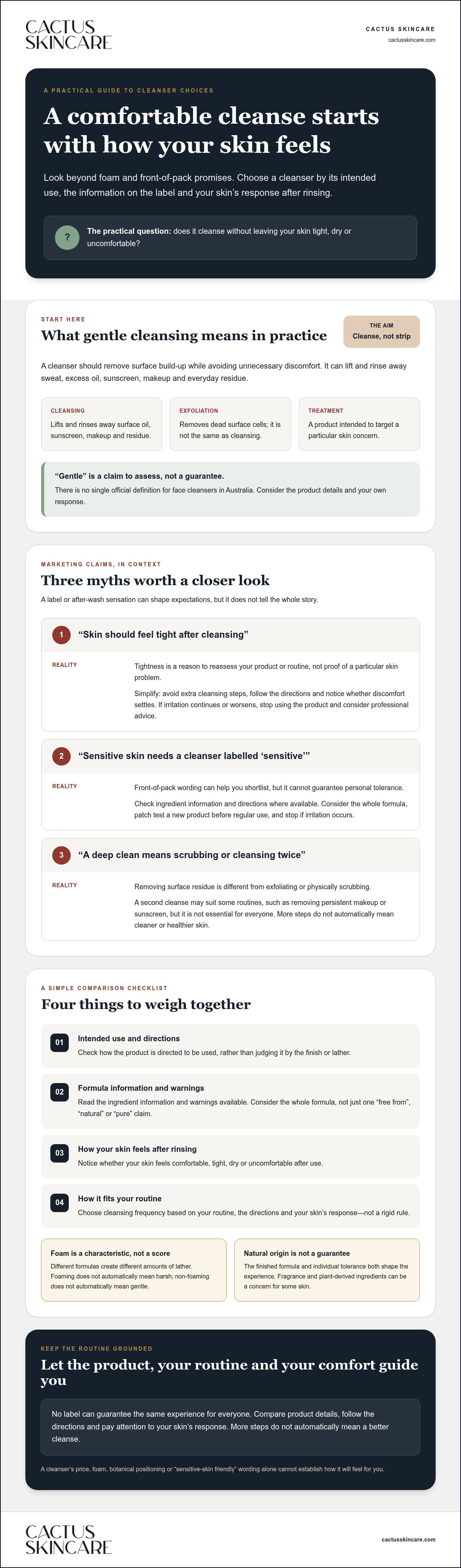
Skin that feels tight, dry or uncomfortable after washing can make a basic daily step feel like a problem. A cleanser should remove sweat, excess oil, sunscreen, makeup and everyday residue, but the aim isn’t to leave your face feeling stripped. In practice, gentle cleansing means removing surface build-up without avoidable discomfort.
“Gentle” has no single official definition for face cleansers in Australia, so treat it as a claim to assess, not a guarantee. Consider the label, the formula as a whole, the product directions and your own response. Foam, a fragrance-free claim or botanical ingredients may offer context, but none proves on its own that a product will feel comfortable for you. For a broader overview of cleansing’s role in a comprehensive skin care routine, consider how it fits alongside other daily care rather than expecting a cleanser to do everything.
A simple definition
Cleansing lifts and rinses away surface oil, sunscreen, makeup and residue. It isn’t the same as exfoliation, which removes dead surface cells, or a treatment intended to target a particular skin concern.
Does a cleanser need to foam to clean your face?
No. Foam is a product characteristic, not a reliable score for cleansing quality. Surfactants help loosen and lift oil and residue so they can be rinsed away, and different formulas create different amounts of lather. A foaming cleanser isn’t automatically harsh, and a non-foaming one isn’t automatically gentle. Check how the product is directed to be used, then notice how your skin feels after rinsing.
Is natural skincare automatically gentle?
No. An ingredient’s botanical origin doesn’t establish how the finished formula will suit every person. The whole formulation and individual tolerance both shape the experience. Fragrance and plant-derived ingredients can be a concern for some skin, just as other ingredients can be. When comparing a gentle face cleanser Australia shoppers might consider, look beyond words such as “natural” or “pure” and check the ingredient information and directions available for that product.
Think in terms of details you can assess, not a promise suggested by one word. Read the label, follow the directions and notice whether discomfort follows use. That gives you a more useful starting point than choosing by foam or botanical positioning alone.
Three gentle face cleanser myths that can mislead Australian skincare shoppers
A cleanser’s price, label or after-wash sensation can shape expectations, but none tells the whole story. Dermatology discussions of common skincare myths also question the idea that natural ingredients are always better. Use these myth-versus-reality checks to assess a cleanser in context rather than by a single promise.
Myth: skin should feel tight after cleansing
Reality: Tightness is a reason to reassess your product or routine, not proof of a particular skin problem. One sensation can’t identify its cause. Try simplifying your routine: avoid adding extra cleansing steps, follow the product directions and observe whether discomfort settles. If irritation continues or worsens, stop using the product and consider seeking professional advice.
Myth: sensitive skin needs a cleanser labelled “sensitive”
Reality: Front-of-pack wording can help you shortlist, but it can’t guarantee personal tolerance. Check the ingredient list and directions where available, and consider the formula as a whole rather than relying on one “free from” or botanical claim. Patch test a new product before regular use, and stop if irritation occurs. The label is a clue, not a prediction.
Myth: a deep clean means scrubbing or cleansing twice
Reality: Removing surface residue is different from exfoliating or physically scrubbing. A second cleanse may suit some routines, such as when you want to remove persistent makeup or sunscreen, but it isn’t essential for everyone. More steps don’t automatically mean cleaner or healthier skin. Let your routine, the product directions and your comfort guide the choice.
Price and plant-based positioning deserve the same measured approach. A higher price doesn’t establish that a cleanser is gentler, and botanical origin alone doesn’t show how the finished formula will feel on your skin. When comparing a gentle face cleanser Australia shoppers might choose, weigh three things together: the formula information, the directions and your skin’s response after use. No single label or ingredient can guarantee the same experience for every person.
If you’d like to compare cleanser options, review the Lemon Myrtle cleanser and Cleansing Balm from Cactus Skincare. Use the available product information to make your own assessment. A product name alone isn’t proof of suitability or gentleness.
How to compare gentle face cleansers without relying on marketing claims
Once you’ve looked past headline words such as “clean”, “pure” and “gentle”, compare the practical details. Texture can help you picture how you’ll use a product, but the directions, intended use and your own experience matter too. Advice from Australia's leading dermatologists also highlights that skincare routines can differ with skin type, so treat recommendations as context rather than a universal prescription.
Quick cleanser comparison
Texture: Note whether the cleanser is a balm, gel, cream or another format, and whether that texture feels manageable in your routine.
Directions: Check how the product is meant to be applied and removed. Follow the instructions rather than assuming every cleanser is used the same way.
Intended use: Consider what the product says it is designed to cleanse, such as everyday residue or makeup. Don’t infer a special function from texture alone.
Afterwards: Notice whether your skin feels comfortable or experiences persistent tightness or irritation. This is an observation, not a medical test.
What should you check on a face cleanser label?
Look for the full ingredient list, directions and any relevant warnings. Read the ingredients in the context of the whole formula: one ingredient rarely tells you how a finished cleanser will feel or suit you. Be careful with therapeutic or performance claims. Before repeating them in skincare content, verify what the product specifically claims and whether reliable evidence supports it.
Which cleanser format might suit your routine?
A balm and a gel may differ in feel and in their stated application or removal directions. Neither format is universally better for dry, oily or reactive skin. Check the product information to see whether the texture and instructions fit your habits. Cactus Skincare offers a Cleansing Balm, but check the current product details for its ingredients and directions rather than assuming how it should be used.
How should skin feel after cleansing?
Notice whether your skin feels comfortable after rinsing and whether tightness or irritation persists. These are useful personal observations, not a diagnosis or a test of skin health. Weather, other products and routine changes can also influence how skin feels, so consider what else has changed before drawing conclusions. Seek professional advice if irritation is significant or persistent.
A practical cleanser choice weighs the formula, directions and your own skin response together, without treating any one label or ingredient as a guarantee. That’s a steady way to compare options and make a considered choice.
How to use a gentle face cleanser without over-cleansing
A comfortable routine is usually a considered one, not the longest one. How often you cleanse depends on what your skin encounters during the day, the rest of your routine, the product directions and how your skin feels. Australia’s climate varies widely, so don’t assume one cleansing schedule suits everyone across the country.
How often should you wash your face?
Many people choose to cleanse in the evening to remove the day’s build-up. Whether to cleanse in the morning can come down to preference and how your skin feels. Consider sunscreen, makeup, exercise and the product’s directions when deciding what makes sense for you. If your skin repeatedly feels uncomfortable, review your routine and reduce unnecessary cleansing rather than adding extra steps by default.
What is a gentle way to cleanse?
Start with clean hands and follow the cleanser’s directions. Use a light touch, avoid abrasive tools and don’t scrub or cleanse for longer than directed. Very hot water can feel uncomfortable, so choose water that feels comfortably warm. Rinse as instructed, pat your skin dry rather than rubbing, then apply a moisturiser if it suits your routine.
When should you stop using a cleanser?
Stop using a cleanser if it causes concerning or persistent irritation. Check the ingredient list and consider whether other products or routine changes may also be relevant. A patch test can be useful, but it can’t guarantee that a reaction won’t occur. If symptoms continue or are significant, seek advice from a qualified health professional.
Cleanse with a light touch, follow the directions and pay attention to how your skin responds. That’s a practical starting point for choosing and using a gentle face cleanser, without treating any schedule as a rule for everyone.
To explore Cactus Skincare’s cleanser options, take a look at the Lemon Myrtle cleanser and Cleansing Balm. Check each product’s current ingredient information and directions to decide whether it fits your routine.
Choosing a gentle face cleanser in Australia: a calm next step
Choosing a cleanser doesn’t need to mean decoding every trend or searching for one perfect ingredient. Look at the formula in context, understand how the product is meant to be used, and consider whether it fits your routine and feels comfortable on your skin. No single label, ingredient or texture can guarantee a universally gentle experience.
A quick checklist before choosing
Before adding a cleanser to your routine, pause over the practical details:
- Check the formula in context. Read the current ingredient information where available, rather than relying only on broad front-label claims.
- Read the directions. Check how the product should be applied and removed, and note any relevant warnings.
- Consider your routine. Think about the products and steps you already use, including when you need to remove sunscreen or makeup.
- Choose a workable format. The texture and instructions should feel manageable enough to use consistently and comfortably.
- Notice your skin’s response. Comfort after cleansing is useful personal feedback, though it isn’t a medical assessment.
This checklist can help you compare a gentle face cleanser Australia shoppers are considering without treating marketing language as proof. If irritation is persistent or significant, stop using the product and seek qualified advice.
Where Cactus Skincare's cleansers fit
Cactus Skincare is an independent Australian-owned brand. The business states that its products are manufactured in Australia, and its confirmed cleanser offerings include the Lemon Myrtle cleanser and Cleansing Balm. Those names identify products, not evidence of particular ingredients, skin-type suitability or results. Check the current product information and directions before deciding whether either option fits your needs.
That measured approach applies to any cleanser: use the information available, follow the directions and let your own experience inform your choice. A gentle routine is one you can follow without unnecessary steps or discomfort.
If you’d like to review the confirmed options and their current product details, explore Cactus Skincare's facial cleansers.
Choose your next cleanse with confidence
A gentle cleanse is about removing everyday residue without leaving your skin persistently uncomfortable. Foam, botanical positioning, price and labels such as “sensitive” can’t guarantee how a formula will suit you. Instead, check the product information and directions, consider how it fits your routine, and pay attention to your skin’s response.
There’s no single schedule or cleanser format that works for everyone. Keep your routine simple, avoid unnecessary cleansing steps, and reassess a product if discomfort continues. These practical checks make choosing a gentle face cleanser Australia shoppers feel good about a more considered process, rather than a guess based on one claim.
Cactus Skincare is an independent Australian-owned skincare brand, and its brand information states that its products are manufactured in Australia. Its confirmed cleanser offerings include the Lemon Myrtle cleanser and Cleansing Balm. Review the current product details to decide whether either fits your needs, without assuming the name guarantees a particular result or suitability.
Explore Cactus Skincare's facial cleansers and take the next step at your own pace. A simple, attentive routine is a good place to begin.
Frequently Asked Questions
What is the gentlest way to cleanse your face?
Use clean hands, follow the cleanser’s directions and avoid vigorous rubbing or abrasive tools. Rinse as directed, then pat your face dry rather than rubbing it with a towel. Choose water that feels comfortably warm, not very hot. If a moisturiser suits your routine, apply it afterwards. Keep the process simple and notice whether your skin feels comfortable after cleansing.
Is a foaming face cleanser bad for sensitive skin?
Not necessarily. Foam is a product characteristic, not a reliable measure of whether a cleanser is harsh or suitable for sensitive skin. Formulas vary, and individual tolerance does too. Read the ingredient information and directions where available, then pay attention to how your skin responds during use. If a cleanser causes irritation, stop using it rather than assuming the foam alone is responsible.
Can a natural face cleanser still irritate your skin?
Yes. “Natural” describes a marketing or ingredient-origin idea, not a guarantee that the finished formula will suit every person. Botanical ingredients and fragrance can still be a concern for some skin, while the full formula also shapes the experience. Check the ingredient list and directions where available. Patch testing a new product may help you observe your skin’s response, but it can’t guarantee there’ll be no reaction.
How often should you use a gentle face cleanser?
There isn’t one frequency that suits everyone. Your routine, the product directions and your skin’s comfort can help guide how often you cleanse. Some people cleanse in the evening to remove the day’s build-up; others may adjust based on sunscreen, makeup or exercise. If your skin repeatedly feels uncomfortable, review your routine and reduce unnecessary cleansing rather than adding more steps.
What happens if your face feels tight after cleansing?
Tightness is a cue to reassess your cleanser or routine, but it doesn’t identify a single cause or diagnose a skin problem. Consider simplifying your cleansing steps and observe whether the discomfort settles. Check the product directions, and stop using the cleanser if it causes persistent or concerning irritation. For ongoing or significant symptoms, seek advice from a qualified health professional.
Do you need to double cleanse every night?
No, double cleansing isn’t essential for everyone. A second cleanse may suit some routines, depending on the products you use and what you’re trying to remove, but adding another step doesn’t automatically mean your skin will be cleaner or more comfortable. Follow each product’s directions and consider how your skin responds. If cleansing twice leaves it feeling uncomfortable, reassess whether both steps are needed.
Should you wash your face in the morning and at night?
Not necessarily. Many people choose to cleanse in the evening, while a morning cleanse can depend on preference, routine and how their skin feels. Consider the cleanser’s directions and whether you’ve used products or exercised since your last wash. Australia’s climate and individual routines vary, so there’s no single schedule for everyone. If repeated cleansing leaves your skin uncomfortable, consider reducing unnecessary washes.