

Facial Oil for Glowing Skin: How to Choose the Right Formula
The facial oil that helps your skin look glowing may not be the richest one on the shelf. Choosing a facial oil for glowing skin is less about chasing a universal “glow” claim and more about finding a formula that suits your priorities and feels comfortable to use. If you’re concerned an oil will feel greasy or contribute to congestion, that hesitation makes sense. The right choice depends on more than the word “radiance” on the label.
A facial oil can soften skin and help seal in moisture from the steps beneath it, but it doesn’t hydrate on its own or guarantee brighter-looking skin. Nourishing and brightening formulas have different stated roles, and ingredients, texture and your existing routine all deserve a closer look. Knowing what to check can make the choice clearer, not more complicated.
In this guide, we’ll explain what contributes to a healthy-looking glow, compare oil types by skin needs and show how to introduce one thoughtfully. We’ll also look at Cactus Skincare’s Facial Oil - Restorative & Nourishing and Facial Oil - Lightweight & Brightening based on their stated positioning. Check each product’s current information for details that go beyond its name.
Key Takeaways
- “Glow” describes how skin looks, not a diagnosis or a guaranteed result. Look beyond broad radiance claims to a formula’s stated purpose.
- Choose a facial oil for glowing skin by matching its intended focus and verified details to your priorities, rather than relying on marketing language alone.
- Greasy feel and skin response can vary between formulas and people. Check the ingredient list and directions before adding an oil to your routine.
- Compare nourishing and brightening options using the information provided about ingredients, texture, suitability and use.
- Use the stated positioning of Cactus Skincare’s two facial oils as a starting point, then review their current product details to decide which aligns with your needs.
What does facial oil do for glowing skin?
A facial oil is a topical skincare product made with oils that can soften the skin’s surface and help reduce moisture loss. It doesn’t do the same job as every moisturiser or serum, and “glow” isn’t a skin diagnosis. It describes an appearance, not a result any product can guarantee.
A facial oil’s role is to condition the skin’s surface and help limit water loss, not to supply water or treat a skin condition. That distinction matters when choosing a facial oil for glowing skin. A comfortable, smooth surface may reflect light more evenly, while a temporary sheen can simply be oil sitting on the skin.
How can facial oil support a healthy-looking glow?
The skin barrier helps keep moisture in and external irritants out. When the surface feels dry or rough, an emollient product can soften it and support a more comfortable feel. Oils can also act as occlusives, helping slow water loss. This is part of how moisturisers work.
That surface effect isn’t the same as changing pigmentation or treating acne, dehydration or another skin concern. A healthy-looking appearance involves more than shine, and skin responds differently to products. An oil may leave a visible sheen without making skin feel comfortable, so consider both the finish and how your skin feels.
Facial oil, serum or crème: what is the difference?
These names describe formats, not fixed ingredient or performance categories. Serums are often formulated to deliver particular ingredients in a lighter-feeling layer. Crèmes commonly combine water and oils to moisturise. Facial oils are oil-based and can soften the surface or help reduce moisture loss. Formulas vary, so check the ingredient list and product directions rather than assuming every serum, oil or crème behaves alike.
They’re not interchangeable. A facial oil won’t necessarily provide the same ingredients or feel as a serum or crème, and it doesn’t replace every moisturising step. To work out where an oil may fit alongside other products, follow the article’s layering guide and the directions for the product you choose.
Nourishing vs brightening facial oil: which approach suits your goal?
Start with the outcome you’re seeking, then check whether the product information supports that choice. “Nourishing” and “brightening” describe different approaches, but neither label tells you everything about ingredients, texture or how an oil may feel on your skin. When choosing a facial oil for glowing skin, compare your priorities with the specific details the manufacturer provides.
| What to compare | Facial Oil - Restorative & Nourishing | Facial Oil - Lightweight & Brightening |
|---|---|---|
| Stated positioning | Restorative and nourishing | Lightweight and brightening |
| Intended focus | Check the product information for the specific comfort or skin goals it describes. | Check what “brightening” refers to, such as the appearance the product is intended to support. |
| Feel and suitability | Verify the texture and stated skin suitability. Don’t infer richness from the name. | Verify the texture and stated skin suitability. “Lightweight” doesn’t guarantee a particular feel for everyone. |
| Ingredients and directions | Check the current ingredient list and instructions. | Check the current ingredient list and instructions. |
When might a nourishing facial oil be the better fit?
A nourishing approach may appeal if your priority is a comfortable-feeling surface and a supple finish. But the label alone can’t confirm a product’s ingredients, richness or suitability for your skin. Review the complete ingredient list and directions for the specific oil, then consider whether its stated purpose matches what you want from your routine.
What should you look for in a brightening facial oil?
“Brightening” can refer to different appearance-focused goals, so look for a clear explanation of the intended claim rather than relying on the word alone. Check the current product information before drawing conclusions about ingredients or how a formula works. Cosmetic language about radiance isn’t proof that an oil treats pigmentation or a medical concern. For a broader overview of what facial oils do for your skin, Cleveland Clinic also discusses potential benefits and drawbacks.
Neither approach is automatically the better choice. The right comparison depends on your priorities and the details available for each product. To explore the two options, compare the current information for Cactus Skincare’s facial oils, including their ingredients, directions, texture and stated suitability.
Will facial oil feel greasy or clog pores?
Not necessarily. Facial oils don’t all feel or behave the same way. Their finish can vary with the formula, how much you apply and how your skin responds. Some may leave a noticeable sheen or feel too heavy; others may feel more comfortable. A product’s “lightweight” label can be a useful clue, but it can’t guarantee how it will feel on your skin.
Facial oils vary by formula, and no general claim can predict how an individual person’s skin will respond. Oils may help soften the skin’s surface, but they can also feel uncomfortable or cause irritation for some people. “Non-comedogenic” claims shouldn’t be treated as a promise that a product won’t contribute to congestion for every user.
Rather than assuming all oils are greasy or pore-clogging, check the details that can help you make a considered choice:
- Read the full ingredient list instead of judging by the product name alone.
- Check the directions and stated skin suitability in the current product information.
- Notice how your skin feels and looks after introducing the oil, and stop using it if it doesn’t suit you.
Can oily or blemish-prone skin use facial oil?
There isn’t a universal yes or no. Skin type alone can’t tell you how a particular formula will feel or how your skin will respond. If you’re considering an oil, check its ingredients and product directions, then introduce it cautiously. For persistent blemishes or other ongoing concerns, seek advice from a qualified health professional. The selection process below can help you assess whether a lighter-feeling option matches your preferences.
How to spot a formula that may not suit your skin
Discomfort, irritation or a finish that feels persistently too heavy are reasons to pause and reassess. Follow the product directions, and stop using it if irritation develops. Before trying a new formula, consider a patch test according to product guidance. A patch test may help you notice a reaction, but it can’t guarantee irritation won’t occur later or across your face. For ongoing reactions or significant skin concerns, seek professional advice.
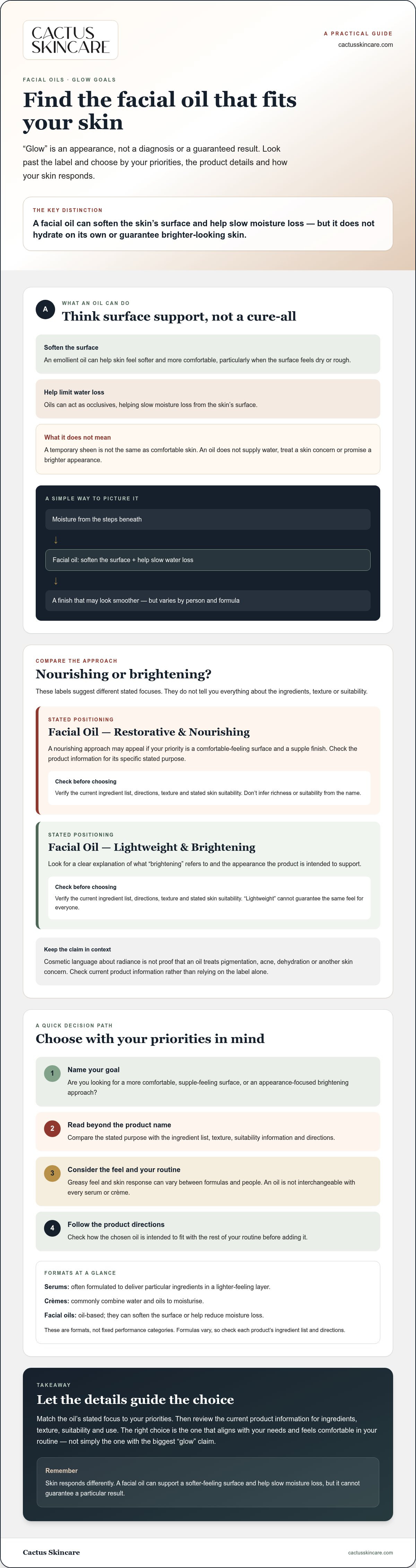
How to choose and introduce a facial oil for glowing skin
Choose by evidence and preference, not by a glow claim alone. Review the product details to decide whether an oil fits your routine and the finish you want. In particular, check the ingredients, directions and stated suitability before buying, rather than trying to infer them from the product name.
Which details should you check before buying?
Read the current product information closely. The ingredient list, directions, warnings and product-specific claims help you understand what you’re considering. Whether you are reviewing blended facial formulas or browsing natural skincare ranges from providers like Freshskin Beauty Ltd, check whether the described texture and intended focus match your preferences, then look for details about suitability instead of assuming a product will suit your skin type. Australian manufacture or botanical positioning may be relevant context, but neither proves clinical efficacy.
Use this selection process:
- 1. Define your desired feel. Decide whether you prefer a lighter finish or a more noticeable nourishing feel. These are personal preferences, not guarantees about how a formula will behave on your skin.
- 2. Review the ingredients. Check the full list and consider any known sensitivities. Don’t infer what an oil contains from its name or marketing category.
- 3. Check directions and warnings. Follow the product’s own instructions and note any precautions or stated suitability.
- 4. Compare claims with your priorities. Look for a clear explanation of what “brightening” or “nourishing” means for that specific product. Match the verified information to your needs instead of treating a broad glow claim as proof of a particular outcome.
How should you trial a new facial oil?
Follow the product directions and consider patch-testing cautiously before broader use. A patch test can’t guarantee that irritation won’t occur. Introduce only one new product at a time, so it’s easier to identify what may be affecting your skin. If persistent irritation or discomfort develops, pause use and seek appropriate professional advice.
For timing, follow the product instructions. The separate guide to when to use facial oil can help you consider where it may sit in a routine. Consistency matters, but there’s no need to push through a formula that doesn’t feel right.
Ready to compare the stated positioning and current product details? Explore Cactus Skincare’s facial oil options and review the information for each before choosing.
Explore Cactus Skincare’s facial oils for your glow goals
There isn’t one facial oil for glowing skin that suits every preference or routine. Cactus Skincare offers two facial oil options with distinct stated positioning: Facial Oil - Restorative & Nourishing and Facial Oil - Lightweight & Brightening. Their names can help you begin comparing, but check the current product information before deciding how either might fit your routine.
Which Cactus Skincare facial oil matches your priority?
If restorative and nourishing positioning aligns with your goal, consider Facial Oil - Restorative & Nourishing as an option to investigate. If lightweight and brightening positioning is closer to what you’re seeking, review Facial Oil - Lightweight & Brightening. Neither is universally best. The choice depends on your priorities and what the verified details say about each formula.
Before deciding, check the relevant product page for the complete ingredient list, directions, texture, stated skin suitability and specific claims. Don’t infer ingredients, feel or performance from a product name alone. Look for a clear explanation of what “brightening” or “nourishing” means for that product, and whether its stated focus matches what you want from your skincare.
What to do before adding an oil to your routine
Review the ingredient list and directions before purchase and use, including any product-specific warnings. Choose one option based on your priorities, then introduce it cautiously and follow its instructions. Trying one new product at a time can make it easier to notice how your skin responds. If irritation or discomfort develops, pause use. Seek appropriate advice if the reaction persists or you have a significant skin concern.
A considered choice starts with clear information, not a promise of a particular glow. Explore Cactus Skincare’s facial oils and compare the current product details at your own pace.
Choose a facial oil with confidence
A facial oil for glowing skin is best chosen by matching its stated purpose and verified product details to your priorities. Nourishing and brightening describe different approaches, not a universal ranking. The formula’s ingredients, directions and feel all deserve a closer look. Introduce your choice thoughtfully and pay attention to how your skin responds.
Cactus Skincare is an independent Australian-owned brand, and its products are manufactured in Australia. Its two facial oil options have distinct stated positioning: Facial Oil - Restorative & Nourishing and Facial Oil - Lightweight & Brightening. Review the current product information to compare their ingredients, directions, texture and claims before deciding which, if either, suits your routine.
Ready to explore the options? Explore Cactus Skincare’s facial oils and take the time you need to choose with care. A considered routine starts with what feels right for your skin.
Frequently Asked Questions
Does facial oil make your skin glow?
Facial oil may give skin a temporary sheen and soften its surface, which can make it look smoother and more reflective. That visible finish isn’t the same as a guaranteed or lasting change in radiance. Results depend on the formula and your individual skin. An oil can support a comfortable-feeling surface, but it shouldn’t be expected to treat pigmentation, acne or other skin concerns.
Can facial oil be used on oily or acne-prone skin?
Possibly, but there’s no universal answer. How an oil feels and how your skin responds can depend on the formula and individual sensitivities. Check the complete ingredient list, directions and any stated suitability instead of relying on a general claim such as “non-comedogenic”. Introduce it cautiously, and seek advice from a qualified health professional if blemishes or other skin concerns persist.
What is the difference between nourishing and brightening facial oil?
“Nourishing” generally describes a product positioned around skin comfort or a supple feel, while “brightening” may refer to a range of appearance-focused goals. These labels don’t confirm a formula’s ingredients, texture or specific effects. For example, Cactus Skincare offers Facial Oil - Restorative & Nourishing and Facial Oil - Lightweight & Brightening. Check each current product page to understand its stated purpose and details.
How do I choose a facial oil for glowing skin?
Choose a facial oil for glowing skin by first deciding what matters most to you, such as a lighter-feeling finish or a nourishing focus. Then review the full ingredient list, directions, warnings, texture description and product-specific claims. Compare that verified information with your preferences rather than relying on “glow” language alone. If you’re unsure how your skin may respond, introduce the product cautiously.
Should I patch-test facial oil before using it?
Yes, consider patch-testing a new facial oil and follow the product’s own directions. A patch test may help you notice a reaction before broader use, but it can’t guarantee that irritation won’t occur later or on another area of skin. Introduce one new product at a time so it’s easier to identify a possible cause. Stop using it if irritation develops.
Can facial oil replace moisturiser?
Not necessarily. Facial oils can soften the skin and may help reduce moisture loss, but they don’t all provide the same functions as a moisturiser. Formulas vary, so check the ingredient list and directions before deciding whether an oil suits your routine. If your skin still feels dry or uncomfortable, an oil alone may not meet your needs.
When should I use facial oil in my skincare routine?
Facial oils are often used towards the end of a routine, after water-based products, but the right order depends on the formula and its directions. Follow the product instructions rather than assuming every oil should be applied in the same way. If you’re layering it with a serum or moisturiser, introduce the oil thoughtfully and observe how your skin feels.