

Facial Oil for Dry Skin in Australia: What Jojoba Oil Can Do
Could a facial oil soothe tightness without doing the whole job? If you’re searching for “facial oil for dry skin Australia”, jojoba is worth understanding, but it isn’t a shortcut to lasting hydration. It may help soften dry-feeling skin, yet it doesn’t replace the role a moisturiser can play in hydrating and supporting the skin barrier.
That distinction matters if dryness persists despite your usual routine, or if a richer oil raises concerns about greasiness or irritation. Jojoba is a wax ester with a structure similar to components of the skin’s natural sebum. That doesn’t guarantee it will suit every complexion or feel weightless on your skin.
This guide explains what jojoba may contribute, how facial oil differs from moisturiser, and where an oil could fit into your routine. You’ll also learn how to introduce one gradually and compare oil-and-moisturiser pairings. Cactus Skincare’s two facial oils offer distinct options to consider, but their names alone don’t indicate that they contain jojoba.
Key Takeaways
- Jojoba may help leave dry-feeling skin softer, but it can’t address every cause of dryness or guarantee barrier repair.
- Compare facial oils and moisturisers by their purpose, texture and place in your routine, rather than treating them as interchangeable.
- When considering a facial oil for dry skin in Australia, look for clear directions and a texture that suits your skin and existing routine.
- Introduce facial oil thoughtfully: cleanse gently, apply a suitable moisturiser, then follow the oil’s product directions.
- Explore distinct options such as Cactus Skincare’s Facial Oil - Restorative & Nourishing and Facial Oil - Lightweight & Brightening.
Jojoba Oil for Dry Skin: What It Can and Cannot Do
Jojoba oil is a plant-derived liquid wax used in skincare to condition and soften the skin’s surface. Its composition is unusual: rather than being a conventional plant oil, it is made largely of wax esters. The Jojoba oil overview explains this distinction and describes its use in cosmetics.
Jojoba’s skincare role is to help condition the skin’s surface and improve its feel, not to serve as a guaranteed, all-in-one moisturiser. An oil may leave skin feeling softer, but it won’t necessarily provide every kind of moisture or comfort your routine needs. Individual responses vary, so an ingredient’s general cosmetic role can’t predict exactly how a finished product will feel on your skin.
What is jojoba oil, and why is it used on the face?
Jojoba comes from the seeds of the jojoba plant. In facial skincare, its waxy, oil-like texture can help smooth and condition the outer surface, which may make dry-feeling skin feel more supple. That describes the ingredient, not a promise of a particular result. The formula, its other ingredients and your own skin all influence how a product performs and feels.
Ingredient information shouldn’t be confused with product claims. Cactus Skincare offers Facial Oil - Restorative & Nourishing and Facial Oil - Lightweight & Brightening as distinct facial-oil options. Jojoba’s general properties don’t establish that either contains it, so check the product’s ingredient information rather than assuming.
Does dry skin need oil, water, or both?
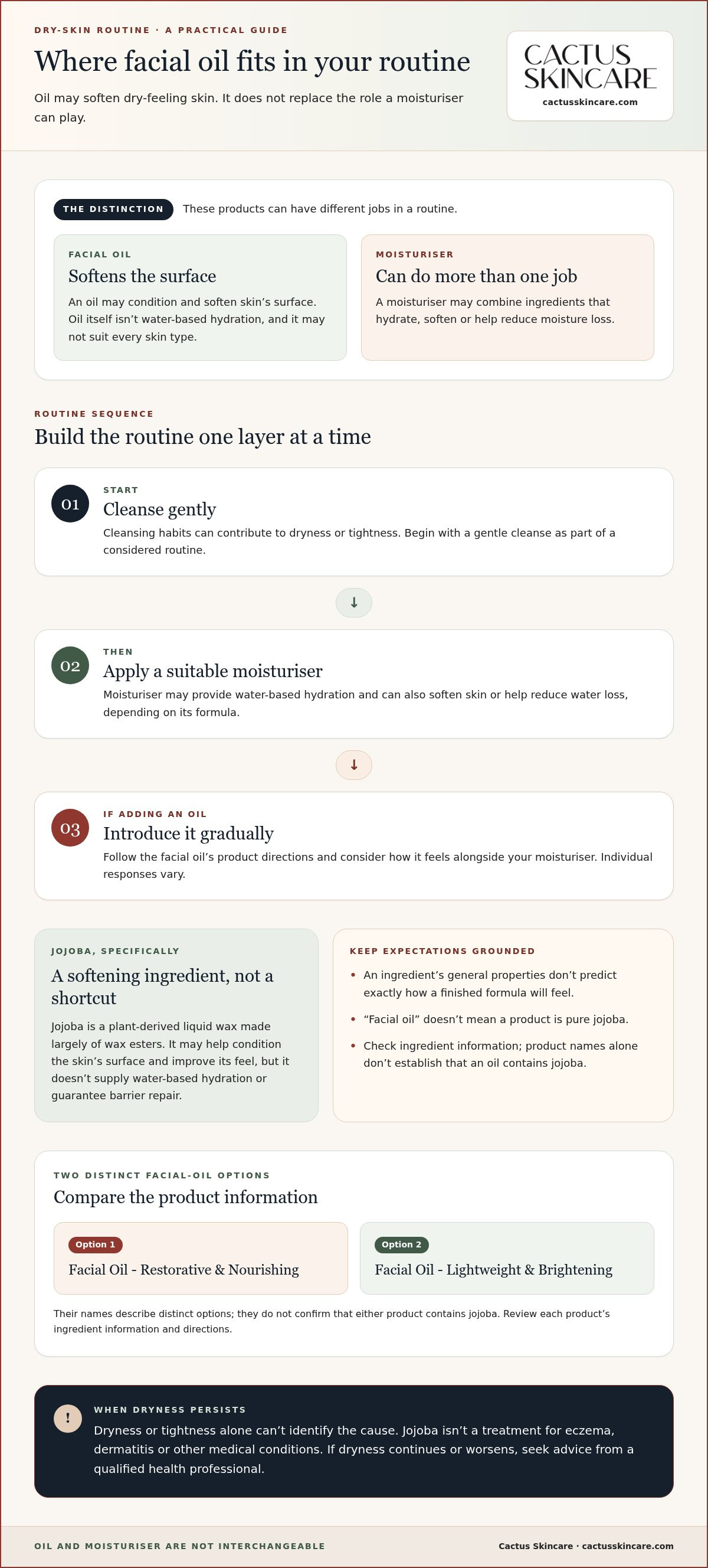
Hydration refers to water in the skin’s outer layers; emollient effects come from ingredients that soften and smooth the surface. A facial oil can contribute to that softer feel, and some oils can help limit moisture loss, but oil itself isn’t water-based hydration. A moisturiser may combine ingredients that hydrate, soften or help reduce water loss, so its role can differ from that of a facial oil.
Dryness or tightness can have different causes, including environmental conditions, cleansing habits and skin concerns. A symptom alone can’t identify the cause. Jojoba oil shouldn’t be treated as a cure for eczema, dermatitis or other medical conditions, and adding oil may not resolve persistent discomfort. If dryness continues or worsens, seek advice from a qualified health professional.
How jojoba oil interacts with dry skin and the skin barrier
The skin barrier is the outermost layer of the epidermis. Its cells and surrounding lipids help limit water loss and protect the skin from external irritants. When this layer is disrupted, skin may feel dry, rough or uncomfortable, but those sensations alone don’t identify the cause.
What does jojoba oil do on the skin’s surface?
Jojoba oil can act as an emollient: it helps soften and smooth the surface, which may make rough or dry-feeling skin feel more comfortable. Cleveland Clinic describes jojoba as close in composition to your skin's normal sebum. That similarity provides context for its cosmetic use, but it doesn’t mean jojoba behaves exactly like your skin’s own oils or suits every complexion.
An emollient helps soften the skin’s surface; water-based hydration adds water to the outer layers, so jojoba oil may support softness without supplying that water. Some oils may also help reduce water loss from the skin’s surface, but the effect depends on the ingredient and finished formula. Jojoba isn’t a guaranteed seal or a universal way to repair a compromised barrier.
What the evidence can, and can’t, tell us
Ingredient properties help explain why jojoba is used in cosmetics, but they don’t establish that every jojoba-containing formula will produce the same result. General ingredient descriptions also don’t prove that a particular facial oil contains jojoba or has been tested for a specific outcome. Formula, application and individual skin can all influence the experience.
A softer feel is a cosmetic benefit, not proof that the skin barrier has been repaired or that an underlying skin condition has been addressed. Even evidence about an ingredient cannot guarantee visible results for every person when it’s used in a finished facial product.
For a considered routine, focus on how an oil feels alongside your moisturiser and follow the product’s directions. Cactus Skincare’s Facial Oil - Restorative & Nourishing and Facial Oil - Lightweight & Brightening have different names and are distinct options to compare. You can explore Cactus Skincare facial oils and review the product information as part of your decision.
Jojoba oil, facial oil, and moisturiser: how to compare them
The terms describe different things. Jojoba is an ingredient; facial oil and moisturiser are product categories, and their formulas can vary. A finished facial oil may blend several oils or other ingredients, so “facial oil” doesn’t mean it’s pure jojoba.
Oil and moisturiser aren’t interchangeable: an oil can condition and soften the skin’s surface, while a moisturiser may combine ingredients that hydrate, soften and help reduce moisture loss. The right choice depends on what your routine needs and how your skin responds. Dry skin doesn’t automatically mean you need to use both.
| Category | Purpose and typical feel | Routine role | What it doesn’t guarantee |
|---|---|---|---|
| Facial oil | Oil-based formula, often with a smooth or rich feel; may soften the skin’s surface. | Can be an additional layer, depending on the product directions and your routine. | It won’t necessarily provide water-based hydration or suit every skin type. |
| Moisturiser | May be a cream, lotion or gel. Formulas can combine water-binding ingredients, emollients and occlusives. | Designed to moisturise, with its specific role shaped by its formula. | Its texture or performance won’t be identical across products. |
| Jojoba oil as an ingredient | A plant-derived liquid wax used in some skincare formulas. | May contribute a conditioning, emollient quality within a finished product. | Its presence alone doesn’t prove a product is a complete moisturiser or will suit everyone. |
Is jojoba oil the same as a facial moisturiser?
No. Jojoba oil names an ingredient, while moisturiser describes a product type. Moisturisers may combine humectants, which attract water, emollients, which soften, and occlusives, which help reduce water loss. A product can include one or several of these functions, but the label alone doesn’t tell you how it will feel on your skin.
When might a facial oil suit dry-feeling skin?
An oil may appeal if your skin feels rough or you’d like a more nourishing-feeling final layer. Climate, personal preference, the rest of your routine and individual tolerance all affect whether that extra layer feels comfortable. If you’re comparing facial oils, change one product at a time and observe how your skin feels, rather than adding several new steps together.
A scientific review of jojoba oil discusses research into its properties and applications. Ingredient-level research isn’t a guarantee of results from every finished product. Cactus Skincare’s Facial Oil - Restorative & Nourishing and Facial Oil - Lightweight & Brightening are two distinct options to consider. Compare their product information and consider which texture and routine role you prefer. Explore Cactus Skincare facial oils as part of your decision.
How to introduce jojoba oil into a dry-skin routine
Keep the change simple. A measured routine makes it easier to notice whether a new facial oil feels comfortable, without layering several unfamiliar products at once. Start with the product’s directions, since the right order and application method can vary between formulas.
Where does facial oil go in a skincare routine?
A gentle cleanse is a considered first step, followed by a moisturiser that suits your skin. You could then consider facial oil as a final layer, particularly if you want to add a soft, conditioned feel. This is one possible sequence, not a strict rule: product texture and label directions take precedence. For more detail on choosing an order, see our guide on when to use facial oil.
Follow this simple framework:
- Cleanse gently. Avoid turning your routine into a test of multiple new products at once.
- Apply your moisturiser. Choose one that already feels comfortable for your skin.
- Consider facial oil. If the directions allow, add a small amount as an extra layer. There’s no universal amount that suits every formula or face, so follow the label.
How can you introduce an oil thoughtfully?
Read the product directions before applying it. If you’re cautious about sensitivity, trial the product on a small area first and observe your skin’s response. This can help you notice discomfort, but it can’t rule out every possible reaction. Introduce one new product at a time and keep the rest of your routine steady so you can better identify what suits you.
If irritation persists, stop using the product and seek appropriate health advice. A facial oil isn’t a substitute for professional guidance about ongoing skin discomfort.
Skin comfort can also shift with the conditions around you. Australia spans varied climates, and indoor heating, air conditioning, humidity and seasonal changes may influence how a routine feels. You might prefer a lighter-feeling layer in one setting and a richer-feeling one in another. Let your own skin and the product directions guide you rather than assuming one routine suits every household.
Cactus Skincare offers two distinct facial-oil options: Facial Oil - Restorative & Nourishing and Facial Oil - Lightweight & Brightening. Compare their product information and directions, then choose the option that best suits your preferred texture and routine.
Choosing a facial oil for dry skin in Australia: a considered next step
A considered choice starts with your routine, not a trend. If you’re looking for a facial oil for dry skin in Australia, focus on the product’s intended feel and directions rather than assuming every oil performs the same way. Australian-made origin can be useful context, but it doesn’t prove a product will suit your skin or treat a skin concern.
What should you look for in an Australian facial oil?
Use this checklist to narrow your choice:
- Intended feel: Think about whether you prefer a lighter finish or a richer, more nourishing-feeling layer.
- Routine compatibility: Consider how the oil may fit with your current moisturiser and other products, and follow the stated application directions.
- Ingredient transparency: Read the full ingredient list. The category “facial oil” doesn’t mean a formula is pure jojoba, so check rather than assume.
- Clear directions: Look for guidance on how and when to apply the product. Follow its instructions instead of relying on a universal amount or routine.
Personal preference matters. An oil that feels comfortable in one routine or season may feel too rich in another. Introduce a new product thoughtfully and assess how your skin responds before making further changes.
How Cactus Skincare’s facial oils fit the choice
Cactus Skincare is an Australian-owned brand, and its products are manufactured in Australia. That origin is one detail to consider, not evidence of a particular ingredient, a guaranteed result or a treatment effect. For suitability, look to each product’s ingredient information, directions and intended feel, then consider how it fits your routine.
Two distinct options are Facial Oil - Restorative & Nourishing and Facial Oil - Lightweight & Brightening. Their names distinguish the products, but don’t indicate that either contains jojoba. Compare their product information with your preferred texture and routine needs, then make a measured choice.
Browse Cactus Skincare facial oils and consider which option may fit comfortably within your skincare ritual.
Choose a considered next step for your dry-skin routine
Jojoba oil may help soften dry-feeling skin, but it isn’t a guaranteed barrier repair or a complete moisturiser. Think of facial oil as a possible extra layer, follow the product directions, and introduce one new product at a time so you can assess how your skin responds.
The right facial oil depends on your preferred feel and how the product works within your routine. Cactus Skincare is an Australian-owned skincare brand, with products manufactured in Australia. Its two distinct facial-oil offerings are Facial Oil - Restorative & Nourishing and Facial Oil - Lightweight & Brightening. Compare their product information and directions to find an option that feels right for your ritual.
Explore Cactus Skincare’s facial oils and take a thoughtful step towards a routine that feels comfortable for your skin. Small, considered changes can help you discover what works for you.
Frequently Asked Questions
Does jojoba oil help dry skin?
Jojoba oil may help dry-feeling skin feel softer because it can act as an emollient, smoothing the skin’s surface. That’s different from water-based hydration, and it doesn’t mean jojoba will resolve every cause of dryness or repair every skin-barrier concern. Results vary between people and products. Follow the product directions and seek professional advice if symptoms persist or feel uncomfortable.
Can I use jojoba oil on my face every day?
Some people may choose to use a jojoba-containing product regularly, but daily use isn’t right for everyone. Let the product directions, your skin’s response and the rest of your routine guide frequency. Introduce one new product at a time so you can notice how your skin feels. Stop using it if persistent irritation develops. An oil isn’t automatically a replacement for moisturiser or daily sun protection.
Is jojoba oil better than moisturiser for dry skin?
Neither is automatically better, because jojoba oil and moisturiser aren’t interchangeable categories. Jojoba is an ingredient, while a moisturiser is a finished product that may combine ingredients with different roles. A facial oil may help skin feel softer; a moisturiser may offer a different combination of moisturising ingredients. The suitable option depends on the formula, how it fits your routine and your personal preference.
How do I use jojoba oil in a dry-skin routine?
Follow the product label and introduce the oil gradually. One approach is to apply it after moisturiser as a later layer, provided the directions allow, but texture and instructions can affect the order. Change one step at a time and observe how your skin responds. This measured approach can help you assess comfort, but no particular sequence suits everyone or guarantees relief from an underlying skin concern.
Can jojoba oil replace face cream?
Don’t assume jojoba oil can replace every face cream. Jojoba is an oil ingredient, while a cream may combine different types of moisturising ingredients in one formula. An oil may complement a routine if you like its feel, but whether it meets your needs depends on the specific product and your skin. If dryness or irritation persists, seek advice from a qualified health professional rather than relying on oil alone.
Is jojoba oil suitable for sensitive skin?
It may suit some people, but jojoba oil isn’t universally gentle or irritation-proof. Check the full ingredient list and follow the product directions. Introduce one new product at a time; a small-area trial may help you observe an initial response, but it can’t rule out every possible reaction. If irritation persists, stop using the product and seek appropriate health advice before adding other new skincare products.
What is the difference between jojoba oil and facial oil?
Jojoba oil is a particular botanical ingredient; facial oil describes a finished skincare product category. A facial oil may contain jojoba, another oil or a blend, so check the ingredient list rather than assuming. Finished products can also differ in texture, directions and intended place in a routine. The name alone doesn’t tell you whether a facial oil is pure jojoba or how it will feel on your skin.